

Idanha-a-Velha
Flights      Hotels      Car Hire    Tours        

IDANHA-A-VELHA

Idanha-a-Velha sits in the centre of Portugal and stands out as one of the country’s most interesting historic villages. Its story goes back more than 2,000 years, having served as a Roman city, a Visigothic settlement, and a key medieval stronghold.

Today, Idanha-a-Velha feels like an open-air museum. Visitors can walk among ancient ruins and enjoy the quiet charm of rural Portugal. Its cobblestone streets, Roman walls, and archaeological sites make it a great spot for anyone interested in history or looking for a peaceful getaway. Surrounded by the stunning landscapes of the Beira Baixa region, this village is also a gateway to some of Portugal’s best hiking trails, traditional cuisine, and historic towns.

A BRIEF HISTORY

Idanha-a-Velha - Pelourinho

|  Pelourinho - Idanha-a-Velha

Idanha-a-Velha was once a vital centre in Iberia. The Romans founded it in the 1st century BC and called it Egitânia. Over time, it became a busy hub for trade and administration, serving travellers from many empires. Even now, the old Roman walls show the order they brought to the land.

Then came the Visigoths in the 5th and 6th centuries AD, bringing with them not just a taste for governance but for theology. They established one of Iberia’s most important Christian dioceses, turning Idanha-a-Velha into a place where politics and piety rubbed shoulders in equal measure.

The Moors arrived in the 8th century and stayed long enough to weave their mark into the fabric of the village before Christian forces reclaimed it in the 12th century. The Knights Templar, in their usual fashion, lent a hand in defending its ramparts, giving the place an almost mythic quality.

In recent times, Idanha-a-Velha became a quiet rural village with fewer than a hundred residents. Still, as you walk its cobbled streets and see the Roman stones, Visigothic carvings, and old walls, you notice a lasting sense of history. The village feels like an open-air museum, where every stone tells a story from the past. For the traveller, Idanha-a-Velha is a reminder that history isn’t neatly filed in museums—it lingers, stubbornly, in the open air of Portugal’s heartland.

A ROMAN HERITAGE

By the late 3rd and early 4th century AD, the Romans of Idanha-a-Velha decided their bustling city needed sturdy ramparts. The result is an oval-shaped enclosure of about 750 metres, curving gracefully with the river. This was no ordinary wall—it was a masterclass in recycling. Stroll along today and you’ll see columns, capitals, friezes, and inscriptions from older Roman buildings jammed into its fabric, like a stone scrapbook of lost grandeur.

The wall is reinforced by semicircular and rectangular towers spaced neatly around its perimeter. Yet its construction shrank the city’s footprint, leaving some unlucky homeowners and even a set of public baths on the outside. Later centuries brought repairs and adjustments, with the Knights Templar stepping in to turn the old Roman wall into a fortress, crowned by a tower built over the podium of a temple that once honoured pagan gods.

The North Gate, still an impressive sight, is flanked by twin circular turrets. Three perfect Roman arches remain, their stones carrying the faint impressions of original hinges. Pointed directly towards Braga (then Bracara Augusta), this gateway once linked Idanha-a-Velha to the wider Roman world—and today, it still feels like a portal to history.

The Romans were never ones to settle for a village without a decent road, and in Idanha-a-Velha they went one step further—laying out a network that tied this Iberian outpost neatly into the empire. At the heart of it all stood a stone bridge, elegant in its simplicity, arching over the River Pônsul. Though time and floods have eroded much of its fabric, what remains today is a tantalising glimpse of Roman engineering: broad blocks, perfect symmetry, and a design so sound that it has survived for two millennia.

The bridge linked Idanha-a-Velha directly to the great Roman highways stretching to Mérida in Spain and Braga in the north. Imagine the traffic—legionaries on the march, merchants with carts piled high, pilgrims clutching relics, all trundling across its arches beneath the Iberian sun. Even now, the traces of those roads are visible: worn paving stones, fragments of causeway, ghostly reminders of a civilisation obsessed with order and movement.

To walk here is to trace the footsteps of Romans, Visigoths, and Templars alike. The countryside around the bridge is quiet, green, and improbably peaceful, yet beneath your feet lies the infrastructure of empire—a testament to ambition, durability, and Rome’s eternal appetite for connection.

North Gate - Idanha-a-Velha

|   North Gate - Idanha-a-Velha


Roman Bridge - Idanha-a-Velha

|   Roman Bridge - Idanha-a-Velha


EPISCOPAL PALACE & VISIGOTHIC CATHEDRAL

Idanha-a-Velha - Pelourinho

|   Visigothic Cathedral


Cheap flights to Portugal

Together, the Episcopal Palace and the Visigothic Cathedral form the heart of this remarkable archaeological site, where history layers itself like sediment along a riverbank.

The Episcopal Palace, built atop earlier Roman structures, is a robust yet dignified residence. Its thick granite walls and simple lines whisper of bishops who once wielded immense power here, when Idanha-a-Velha was the seat of one of the most influential Christian dioceses of the Visigothic kingdom. You can still see fragments of Roman stonework reused in its construction—capitals, inscriptions, and friezes cannibalised from the empire’s ruins, a kind of architectural recycling long before it was fashionable.

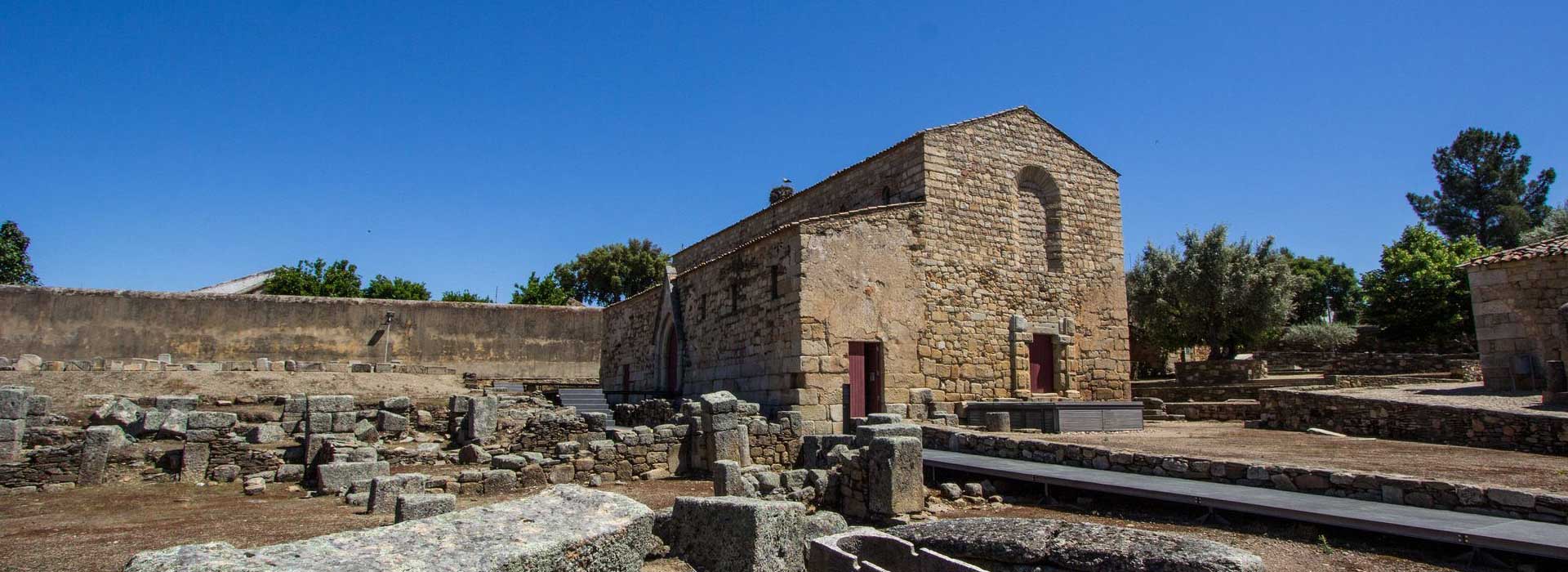
Next door, the Visigothic Cathedral remains the crown jewel. Built in the 5th or 6th century, it’s one of the oldest Christian temples in Portugal. Step inside and an austere interior greets you, its columns carved with anthropomorphic motifs, its arches solid and enduring. Though altered over centuries by Moors, Christians, and even the Knights Templar, the cathedral retains an air of solemnity, as if time itself still prays here. Wander the grounds and you’ll find Roman tombstones, crumbling walls, and the traces of ancient cloisters.

From the calm of the Sé (Cathedral) Square, a short stroll delivers you to the Lagar de Vares, an old olive oil press that proves industry can be as poetic as agriculture. This is not just a relic of rural toil, but a monument to human ingenuity, showing how generations of farmers squeezed gold from the humble olive and turned it into the lifeblood of the region.

Step into the courtyard, and history takes another twist. Here stands a sleek modern pavilion built over the remains of the old boiler wall. Within it lies one of the most remarkable Roman epigraphic collections in Iberia—stone inscriptions that whisper the names and deeds of a world long gone.

THE TEMPLAR TOWER (TORRE DOS TEMPLÁRIOS

The Templar Tower (Torre dos Templários) rises like a stubborn stone sentinel, a reminder that even the smallest of villages once carried the weight of empires, faith, and fear. Built in the 12th century by the Knights Templar, the tower was grafted onto the remains of a Roman temple podium—a clever recycling project in an age when stones were as valuable as soldiers. Here, granite blocks carved by the Romans for the glory of Jupiter were repurposed into a fortress of Christ.

The tower itself is stark and uncompromising, a square block of granite that seems more like a geological formation than a building. Yet its presence dominates Idanha-a-Velha. From its summit, you can see over the olive groves, stone-walled lanes, and the ruins of Roman walls that once circled the town. In its time, this was both a watchtower and a stronghold, a symbol of Templar power in the borderlands of Portugal, when Christian knights stood guard against Moorish incursions.

Step inside and you find a cool, echoing interior, stripped bare but still heavy with atmosphere. It doesn’t take much imagination to picture mailed knights planning campaigns here, maps unrolled, swords propped in the corner. The tower connects you to that feverish period of faith, battle, and secrecy.

Outside, the site is a jigsaw of Roman, Visigothic, and medieval stones—yet the Templar Tower looms above them all, severe and unyielding.

Templar Tower (Torre dos Templários) - Idanha-a-Velha

|  Templar Tower (Torre dos Templários) - Idanha-a-Velha

TOP TOURS

Private Tour 3 Villages 1 day Belmonte Sortelha and Sabugal

Private Tour 3 Villages 1 day Belmonte Sortelha and Sabugal

In the heart of Cova da Ribeira and with a privileged view over the eastern slope of Serra da Estrela, you will find Belmonte. The land that saw the birth of Pedro Álvares Cabral, cradle of good people, but also of endless landscapes and centuries of history. Passage through the Medieval Castle, Pelourinho, Sidewalk and Medieval Wall, Paços da Via Sacra, Anthropomorphic Graves and Church of NS das Neves in Sortelha. In the center of Portugal, in the district of Guarda, is what is nicknamed Castelo das Cinco Quinas. It was in the reign of D. Dinis when the castle of Sabugal became part of Portuguese territory, after several disputes with the kingdom of León, its nationality was decided in the Treaty of Alcanices (or Alcanizes), on 12th September, 1297.

(2) | 6-8 Hr | ✔ Free Cancellation

Book Online ►

Full-Day Portuguese Historical Villages Tour

Full-Day Historical Villages Tour

Steep yourself into the rich history of Aldeias on this full-day historical tour. Immerse in Northern Portugal’s storied villages with the help of a knowledgeable bi-lingual guide. Visit Celorico da Beira and Linhares da Beira, where your guide will illuminate their culture for you. Learn about Rome’s influence on the stone architecture and paved roads and also see the Castle of Linhares and the equally stunning Church of Santa Maria. This is a great opportunity for any history buff or intrepid traveller.
• A full-day historical tour of Aldeias
• Learn about the origins of Portugal
• Discover quaint stone houses and winding country roads
• Get to know the culture of this charming place
• See the Castle of Linhares and Church of Santa Maria.

(7) | 10 Hr | ✔ Free Cancellation

Book Online ►

Tour Serra da Estrela Manteigas Belmonte

Tour Serra da Estrela, Manteigas & Belmonte

On this tour you will have the opportunity to discover the fantastic landscapes of Serra da Estrela, with a maximum altitude of 1993 metres in Torre da Serra da Estrela. Belmonte, a municipality almost as old as Portugal itself, Installed in the so-called Monte da Esperança, where its remote Castle began in the 12th century, with panaramic views over Serra da Estrela, its rich history is deeply associated with the history of Cabrais, as well as that of the Jewish community in Portugal.
Meet of the guide/driver at the Hotel at 09:00. Departure to Serra da Estrela, on the Covilhã side, with a stop at the Varanda dos Carqueijais, with stunning views of Cova da Beira.

(2) | 7 Hr | ✔ Free Cancellation

Book Online ►

WHERE TO STAY IN IDANHA-A-VELHA

Hotel Vila Raia

Hotel Vila Raia ★ ★ ★

9.2/10 Wonderful (7) verified customer reviews)


The Hotel Vila Raia in Idanha-a-Nova is a revelation – a modern retreat with rural charm, perfectly placed for exploring the historic landscapes of Central Portugal. Arriving here feels like stepping into a sunlit postcard: wide terraces, shimmering pool, and sweeping views of olive groves and granite hills. Rooms are spacious, elegantly simple, and blissfully quiet – the kind of space where one can hear both birdsong and one’s own thoughts. The restaurant celebrates Portuguese gastronomy with hearty regional flavours, while the staff glide about with effortless warmth. For those visiting Idanha-a-Nova, Monsanto, or Idanha-a-Velha, this is a base that combines comfort with authenticity. In short, a countryside hotel where serenity and style sleep side by side. Utterly restorative.

Zona Industrial Rua A, Lote 1, Idanha-a-Nova, Castelo Branco, 6060-182, Portugal.
39° 56' 47.3" N | 07° 14' 42.5" W

Check Availability

Casa do Cedro

Casa do Cedro ★ ★ ★

9.0/10 Wonderful (9 verified customer reviews)


Casa do Cedro is a rustic jewel polished to a gentle shine – a holiday home that exudes both charm and authenticity. Set amid olive groves and rolling countryside, this traditional stone house offers guests the full flavour of rural Portugal, wrapped in comfort. The interiors are elegantly simple: cool stone walls, wooden beams, and tastefully restored furnishings that whisper of history while ensuring modern ease. Outside, a tranquil garden and the namesake cedar tree provide shade and serenity – the perfect spot for a glass of local wine. Located close to Idanha-a-Velha and Monsanto, Casa do Cedro is an ideal base for exploring the region’s heritage. A stay here feels like inhabiting a Portuguese dream, timeless and invigorating.

Av. Medina 13, Idanha-a-Nova, Castelo Branco, 6060-051, Portugal. | 40° 02' 57.3" N | 07° 11' 03.1" W

Check Availability

Quinta de São Pedro de Vir-a-Corça

Quinta de São Pedro de Vir-a-Corça

10/10 Exceptional (16 verified customer reviews)


Quinta de São Pedro de Vir-a-Corça is the sort of hideaway that feels plucked from a painter’s canvas – rustic, romantic, and utterly beguiling. This charming rural guesthouse, set against the dramatic granite backdrop of Portugal’s most historic village, offers visitors an authentic taste of Beira Baixa hospitality. The stone-built farmhouse has been lovingly restored, with rooms blending traditional simplicity and modern comfort. Think terracotta floors, wooden beams, and views of Monsanto’s medieval rooftops tumbling down the hillside. Breakfast is a feast of local cheeses, bread still warm from the oven, and honey from nearby hives. Perfectly located for exploring the “most Portuguese village in Portugal,” the Quinta is a tranquil haven, equal parts history, comfort, and pastoral beauty.

Quinta de S. Pedro de Vir-a-Corça, 1, Idanha-a-Nova, Idanha-a-Nova, 6060-085, Portugal.
40° 02' 13.1" N | 07° 07' 08.1" W

Check Availability

WHERE TO EAT IN IDANHA-A-VELHA

Casa da Amoreira

Casa da Amoreira in Idanha-a-Velha has the audacity to combine rustic Portuguese tradition with the kind of plating that makes Instagrammers swoon. Housed in a restored schist-stone building on Largo da Amoreira, it looks like the sort of place where monks once brewed wine and argued about salvation. The kitchen, however, is far less pious. Goat stew arrives dark, sticky, and utterly unapologetic, the kind of dish that clings to your ribs and your conscience. Octopus, roasted to within an inch of perfection, tastes like it has negotiated a truce with fire and sea. The olive oil is liquid gold, the bread weapons-grade, crusty, and the service knowingly indulgent. It’s indulgence dressed as heritage—and frankly, it works.

Tuesday - Saturday: 09h00 - 21h00, Sunday & Monday: CLOSED
R. da Amoreira 1, Idanha a Velha, 6060-041, Portugal, Portugal.
39° 59' 47.3" N | 07° 08' 37.7" W
+351 960 146 101

Casa da Amoreira

Helana

At Helana, on Rua de Santa Catarina, the promise is rustic comfort dressed up as a homely Portuguese welcome. The room is simple—stone walls, wooden chairs, and the faint perfume of grilled garlic drifting in from the kitchen. What lands on the table, however, is nothing short of lusty. The house speciality is roasted kid goat, slow-cooked until the meat slumps off the bone like a fainting aristocrat. Bacalhau à Brás arrives in a golden, tangled nest of potato and salted cod, perfectly salted without being brash. Desserts lean unapologetically sweet—the almond tart is basically a sugar-laden hug. Helana doesn’t need theatrics: it’s honest, rural cooking in a village that wears its history on every cobblestone.

Monday - Saturday: 12h00 - 14h30/18h00 - 22h30, Sunday: CLOSED
R. José Silvestre Ribeiro 35, 6060-133 Idanha a Nova, Portugal.
39° 55' 18.0" N | 07° 14' 15.7" W
+351 277 201 095

Helana
Castelo Novo

|  Castelo Novo


More About ►

HISTORIC VILLAGES OF PORTUGAL

The Historic villages of Portugal Programme (Programa de Aldeias Históricas) is a restoration programme started in 1991 and encompasses twelve small, yet statically important, ancient villages within the Beira Interior region of Central Portugal. Each settlement involved in the project has, in some way, played a pivotal role in the creation and defence of Portugal throughout history. Originally encompassing ten villages the programme has since been extended to twelve and includes: Almeida, Belmonte, Castelo Mendo, Castelo Novo, Castelo Rodrigo, Idanha-a-Velha, Linhares da Beira, Marialva, Monsanto, Piodão, Sortelha and Trancoso.

Ironically it was peacetime that brought these splendid villages into decline. The regional economy collapsed and the young moved to more urban areas where the way of life is more prosperous and easy. Little by little buildings emptied, populations became older and the villages began to crumble. Since its inauguration the Programa de Aldeias Históricas restoration scheme has not only restored the physical aspects of the villages but also improved public access, and transport, encouraging tourism and thus reanimating the life of these historical homesteads. Today the old people who remained here rub shoulders with visitors eager to witness a living snapshot into the past.

CAPELA DE SÃO DÂMASO

The Capela de São Dâmaso is dedicated to Pope Damasus I, who was born nearby in the 4th century. The chapel is a reminder that even the tiniest Portuguese villages can lay claim to saints, scholars, and stories that stretch far beyond their olive groves.

From the outside, the chapel is disarmingly simple: pale stone walls rising from a patch of grass, topped with a modest cross that has faced both sun and storm. Its Romanesque bones whisper of centuries past, though later touches of Gothic and Baroque give it that layered, lived-in feel so typical of rural Portugal.

Step inside and you’ll find an interior that strikes a balance between austerity and intimacy. The small altar is framed by simple carvings, and a handful of devotional paintings provide splashes of colour in the soft light. You don’t come here for grandeur; you come for atmosphere, for the sense of a place that has seen countless prayers, confessions, and whispered hopes. Capela de São Dâmaso is not just a chapel—it’s a footnote in the epic poem of Portugal.

Capela de São Dâmaso - Idanha-a-Velha

|  Capela de São Dâmaso

MONSANTO

Monsanto

|  Monsanto


Carved out of the living rock the village Monsanto looms over the landscape below. Once considered the most “Portuguese“ of Portugal’s villages, the area has been settled since Palaeolithic times. Ruins of a Roman township stand at the foot of the Monsanto mountain. The Templar Knights were awarded the village following its liberation from the Moors. It was from this period the first castle and stone defences were constructed. The need to protect Portugal’s newly won borders precipitated the reason for Monsanto to exist. Albeit the tough terrain, the associated village thrived as a trading post. Nothing seems to have changed since its heyday in medieval times. The steep, narrow streets have maintained much of their original features, such as granite buildings that utilise the giant boulders that inhabit the hilltop.

Getting to the castle involves a brisk stroll up the hillside but your efforts will be well rewarded by the vistas that await you at the top. Carved blocks seem to mingle seamlessly with the bedrock and exposed rocky outcrops. The castle's Romanesque chapel, Capela de São Miguel, is missing a roof and the stone coffins that surround it are missing their inhabitants. Monsanto is unique in Portugal, if not the world. Not only is it a snapshot in time, the whole village seems to blend into its surroundings.

More About ►

HOW TO GET TO IDANHA-A-VELHA

301 km (187 miles) south east of Francisco de Sá Carneiro Airport PORTO. Website

Hotel Deal in Porto

• From Lisbon: 2.5 hours via A23 and N239.
• From Porto: 3.5 hours via A1 and A23.
• From Castelo Branco: 40 minutes via N239.

Cheap Car Hire in Portugal

The nearest train station is in Castelo Branco, about 40 km away.
• Linha da Beira Baixa line Timetable

Trains of Portugal Website

• Rede Expressos operates countrywide services: Website
• Rodoviária da Beira Interior operates regional services: Website